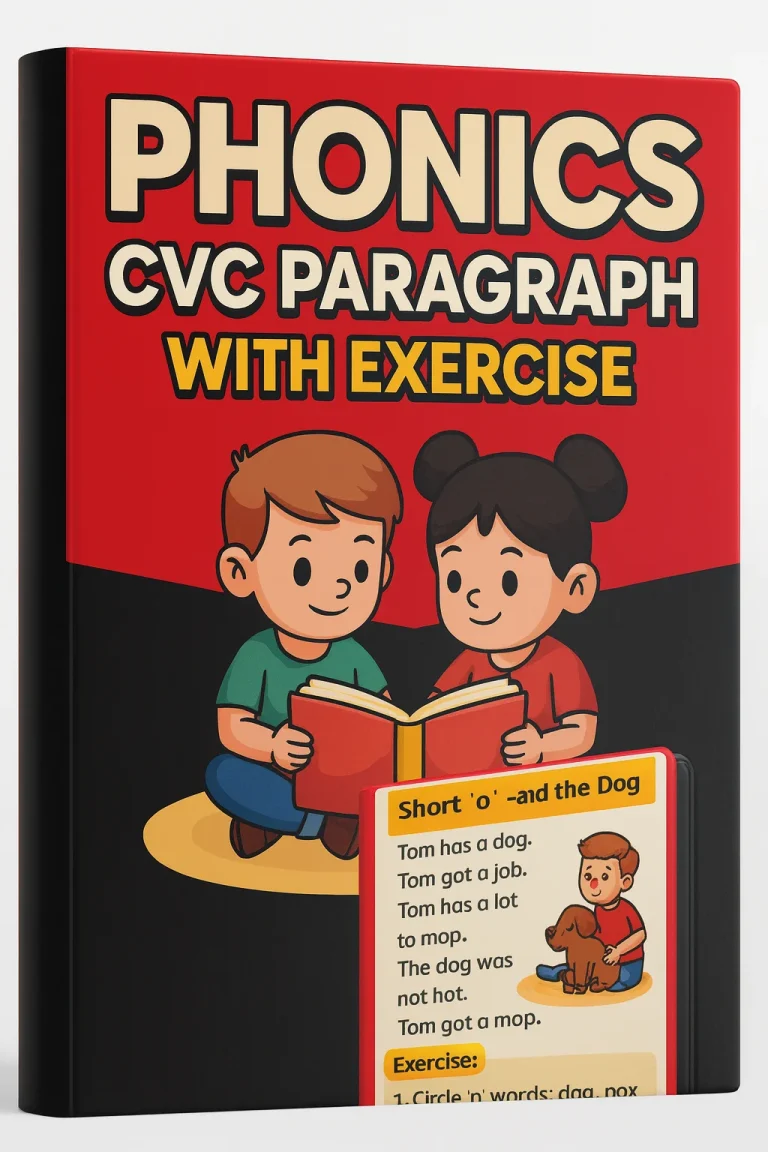
Bridging the Gap: How a Phonics CVC Paragraph with Exercise Transforms Early Readers
There is a palpable sense of excitement in the air when a young learner first begins to decode CVC (Consonant-Vowel-Consonant) words. Suddenly, the letters *c-a-t* seamlessly blend into “cat,” and *s-u-n* confidently becomes “sun.” It’s a monumental achievement. But for many children, a challenge soon emerges: the leap from reading isolated words to fluently navigating a full sentence, let alone a group of sentences. This is precisely where a specialized resource, like a book built around a Phonics CVC Paragraph with Exercise, becomes an invaluable tool, acting as the crucial bridge to confident reading.
Shop for bestsellers
For parents and educators, understanding the design and purpose of this type of book is key to selecting the right materials to nurture a budding reader’s skills and, most importantly, their confidence.
The Power of the Paragraph: Moving Beyond Isolated Words
While flashcards and word lists are excellent for building initial decoding skills, they don’t replicate the act of reading for meaning. A child might be able to read “dog,” “big,” “ran,” and “fast” individually, but connecting them in the sequence “The big dog ran fast” requires a different cognitive muscle. It demands tracking from left to right across a line, maintaining rhythm and pacing, and synthesizing the individual words into a coherent thought.
Discover more
book
Book
books
LIBRARY
Instant Word Power
BOOKS
PDF
Library
Books
Bookshelves
Bookshelves
A well-crafted Phonics CVC Paragraph with Exercise is engineered to strengthen this muscle. The paragraph itself is not a complex story from a standard picture book. Instead, it is a carefully controlled piece of text, often just 3-5 sentences long, constructed almost entirely from CVC words and a few essential sight words (like ‘the,’ ‘and,’ ‘is’).
Here is a classic example of what such a paragraph might look like:
“Dan has a cat. The cat is on a mat. The cat can nap. Dan can pat the cat. The cat is a pal.”
This simple narrative is a powerhouse of learning. It uses a limited set of vowels and consonants, repeats key words for reinforcement, and, despite its simplicity, tells a tiny, complete story. This gives the child the incredible experience of reading a “whole story” independently, a massive boost to their self-esteem.
The Exercise: Where the Magic of Comprehension Happens
The paragraph alone is a fantastic achievement, but the accompanying exercise is what solidifies the learning and transforms reading from a decoding task into an interactive, meaning-making process. A high-quality Phonics CVC Paragraph with Exercise doesn’t just test the child; it guides them toward deeper engagement with the text.
Shop for bestsellers
The exercises typically include:
- Comprehension Questions: Simple questions that check for understanding directly from the text. For the paragraph above, this might be: “Where is the cat?” or “What can the cat do?”. This teaches the child that reading is not just about saying words correctly, but about gathering information.
- Word-Hunting Tasks: Instructions like, “Circle all the words that have the short ‘a’ sound.” This reinforces phonemic awareness within the context of real reading, helping the child see patterns and families.
- Fill-in-the-Blanks: A sentence from the paragraph might be reproduced with a key word missing, prompting the child to recall the vocabulary and context. (e.g., “Dan can ____ the cat.”)
- Drawing or Sequencing: For a more creative touch, an exercise might ask, “Draw a picture of the cat on the mat.” This ensures the child has formed a mental image from the text, a key component of comprehension.
Why This Combination is a Game-Changer for Your Young Reader
Integrating a book that features a Phonics CVC Paragraph with Exercise into your child’s routine offers multifaceted benefits:
- Builds Fluency: The repetitive and predictable nature of the paragraphs allows children to practice reading smoothly and with expression, rather than in a halting, word-by-word manner.
- Demonstrates Practical Application: It answers the child’s unspoken question, “Why am I learning these words?” by showing them that these building blocks are used to create stories and convey ideas.
- Provides Tangible Success: Completing both the reading and the exercise gives the child a clear and concrete “win.” This positive reinforcement is crucial for motivating a reluctant reader.
- Offers a Clear Assessment Tool: For parents and teachers, the exercises provide immediate insight into where a child might be struggling—is it with a specific vowel sound, with comprehension, or with focus?
Bookshelves
Choosing the Right Book and How to Use It Effectively
When selecting a resource, look for books that offer a progressive difficulty, gradually introducing new CVC word families and slightly longer paragraphs. The exercises should feel like a fun activity, not a daunting test.
When sitting with your child, encourage them to read the entire paragraph aloud once through without stopping. Praise their effort! Then, go back and work on the exercise together. Talk through the questions. If they circle the wrong word in a word hunt, gently guide them to listen to the sound again. The goal is patient practice, not perfection.
In essence, a book dedicated to presenting a Phonics CVC Paragraph with Exercise is more than a simple educational tool; it is a confidence-building machine. It takes the abstract skill of phonics and places it squarely into the joyful, tangible world of stories and understanding. By providing this structured bridge, you are not just teaching your child to read words you are empowering them to become a reader.
Shop for bestsellers